 Sv
Sv  En
En 
Share with


Blog
It is now over two years since the pandemic hit Sweden. As more people return or plan to return to the office, organisations are beginning to think about the way they work in the workplace. A question I often ask myself in discussions with HR and property managers is what – or where – their workplace is these days? Is it at home? Is it at the office? Or both? Usually, the answer is “both”, and this trend has led to new concepts such as hybrid workplaces and hybrid ways of working becoming a hot topic. Other popular terms are hybrid work and hybrid offices. But what do these concepts mean? How does the hybrid workplace differ from traditional and flexible offices such as activity-based offices? In this article, I will dig deeper into these concepts.
The hybrid workplace
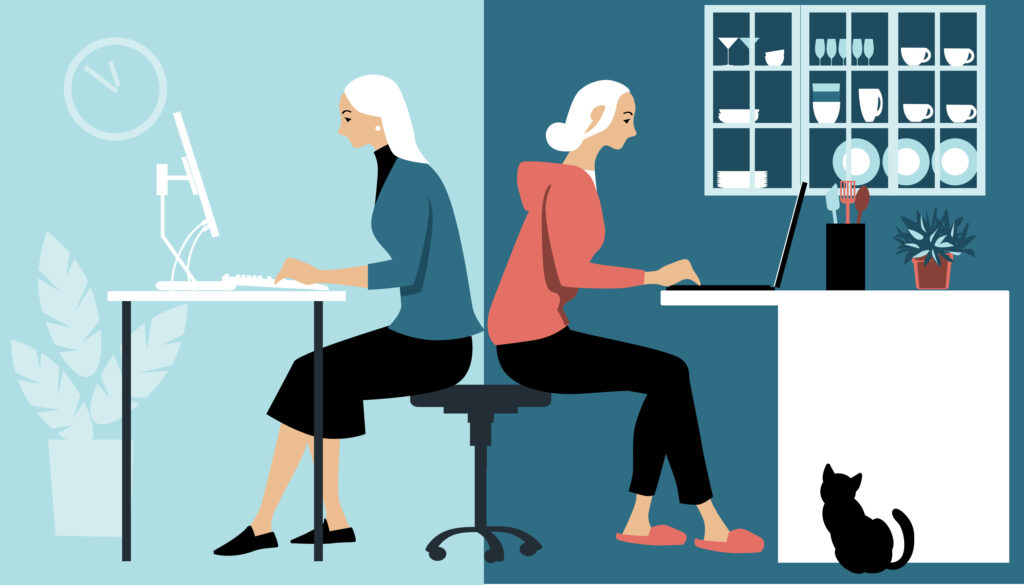
Hybrid ways of working means that employees have the possibility to both work at home and the office, based on an agreement with the employer.
A hybrid approach means that employees have the opportunity to work remotely and are expected to be in the office a few days a week. Working remotely can mean working from home, in a business lounge or elsewhere, as agreed with the employer. Hybrid work thus does not directly define the working method to be applied in the office. When working in a hybrid workplace you can work traditionally at the office with fixed seats, flexibly in a flex office, or flexibly in an activity-based office.
Three reasons why activity-based offices will grow with hybrid working
Activity-based ways of working can mean less isolation in workplaces with a hybrid way of working
But with the increased flexibility and reduced presence hybrid working brings, it is common for organisations to review their office environments and implement activity-based offices, for those parts of the business where this is possible.
There are several reasons to apply greater flexibility in the workplace. On one hand, hybrid ways of working reduce the presence in the office. Before the pandemic, attendance data we reviewed when developing the workplace strategy showed an average office attendance of about 65%. With hybrid work, this figure can drop to 40-60% depending on the degree of flexibility the organization chooses to apply. By shifting to an activity-based way of working one can collect desks together so that those at the office don’t have to sit alone.
Another aspect is sustainability. Reducing vacant space saves energy for heating and cooling surfaces.
Other reasons are to reduce premises costs and to invest in training and ergonomic tools for the home. Hybrid working means that businesses need to invest in providing employees with access to ergonomic tools such as screens, desks, etc. that they can use when working remotely. It also means that there is an increasing need for remote leadership and community-building activities.
Things to consider when implementing a hybrid approach and activity-based offices!
For hybrid working – meet the needs of employees to manage visual information when working remotely.
If you are going to introduce an activity-based office to support a hybrid approach to work, it is useful to reflect on a few points when developing your workplace strategy. First – what do you need the office for? Should your employees still be able to perform – in a good way – individual tasks in the office or should these tasks only be performed remotely? Will the office become a meeting place? Or should all activities be able to be carried out in the office even if you use a hybrid approach?
Keep in mind that while many people enjoy performing individual tasks at home, a lot of office work involves bringing together different types of information that are often visually represented. This means not only graphic material but also text and calculations from different sources. To effectively manage these types of information, computer screens are often needed – the laptop alone is not a sufficient alternative as the ability to visualize large amounts of information is rather limited. Screens, on the other hand, require desk space. This brings us to the challenging fact that not everyone has the space at home to create a good workplace at home. Think, for example, of young couples in small apartments.
Another aspect is that not everyone has the peace at home to be able to focus, and another is that others may feel isolated by too much work at home. It can therefore often be a good idea to offer a diversified working environment in the office with different types of spaces for different types of activities, that also allows for remote work.